
Understanding Crypto Market Psychology: How Emotions Shape Your Trading Decisions

If you’ve ever stared at your screen during a sudden dump, felt your palms sweat, or bought a breakout moments before it reversed – you already know the truth: the crypto market isn’t just charts and liquidity pools. It’s a complex psychological battlefield. The traders who survive long-term aren’t always the most technical, or the most analytical – they’re the ones who learn to master their emotional responses.
In cybersecurity, where I’ve spent much of the last decade, we constantly talk about attack surfaces. In crypto trading, your biggest attack surface isn’t your exchange account – it’s your mind. Emotional vulnerabilities expose you to unnecessary risks, impulsive decisions, and predictable mistakes that more resilient traders avoid.
This article breaks down the core emotional triggers that shape your trading behaviour, how to recognise them, and how to rebuild your mindset so you trade like a long-term professional, not a reactive participant. We’ll use real psychological models, industry-first observations, and mental frameworks you can immediately apply in your own Crypto Mental Log journal.
Why Psychology Matters More Than Charts
Technical analysis acts as a roadmap. Market psychology is the weather. Even the best roadmap is useless in a storm. A chart pattern might imply a breakout, but fear, greed, and crowd reactions determine whether it truly happens.
Studies from the University of Cambridge have shown that physiological stress markers (like cortisol spikes) directly reduce a trader’s ability to evaluate risk accurately. In practical terms, this means that when you’re stressed, the part of your brain that handles strategic decision-making goes partially offline – and you start reacting like a short-term emotional creature.
That’s why taking steps toward managing stress isn’t optional. It’s a competitive advantage.
The Five Core Emotional Drivers in Crypto Trading
After reviewing behavioural economics research and cross-referencing it with live crypto trader data, five emotional forces show up repeatedly:
- Fear
- Greed
- Impatience
- Social pressure
- Overconfidence
The combination of these emotions drives the majority of impulsive decisions on the charts. Let’s break them down.
1. Fear: The Emotional Accelerator of Bad Decisions
Fear enters your system fast – often before you’re aware of it. Humans are wired to prioritise avoidance of threats over seeking rewards. That’s why red candles feel so violent compared to green candles feeling rewarding.
Fear leads to:
- Panic selling at local lows
- Premature stop-loss tightening
- Abandoning successful long-term strategies
- The infamous “I’m out, I can’t watch this anymore” bailout
Reducing fear-driven outcomes requires developing the mindset of a calm, deliberate, long-term investor, similar to what we describe in our framework for the mindset of a long-term trader.
2. Greed: The Illusion of “Just One More Pump”
Greed is subtle. It disguises itself as confidence, ambition, or “seeing potential.” But in reality, it causes traders to:
- Over-leverage
- Hold winning trades far too long
- Lose discipline during bull runs
- Ignore exit plans entirely
The most dangerous form of greed is revenge trading – the belief that you can win it all back quickly after a loss. If you haven’t already, read our breakdown on cutting out revenge trading to prevent this spiral.
3. Impatience: The Silent Killer of Good Setups
Almost every trader struggles with impatience because crypto moves fast – until it doesn’t. The market spends far longer in boring consolidation than explosive highs or lows.
Impatience leads to:
- Entering trades too early
- Forcing setups that aren’t there
- Exiting winners prematurely
- Taking unnecessary micro-trades to “stay active”
I’ve seen traders with perfect technical skill sets fail because they couldn’t sit on their hands. Professional traders win through selective participation, not constant participation.2
4. Social Pressure: The FOMO Engine
Crypto operates inside a constant 24/7 noise machine. The pressure doesn’t only come from charts – it comes from Twitter, Discord, Telegram, influencers, and crowd narratives. This fuels:
- FOMO entries
- Buying tops because “everyone is talking about it”
- Trend-chasing instead of planning
This is why becoming aware of social media influence is critical. Most traders underestimate how much it controls their decisions.
5. Overconfidence: The Hidden Risk After Winning Streaks
Overconfidence shows up most after a winning run. You start to believe the market “makes sense,” or that you’ve developed a superior edge. Then you unknowingly increase risk, overtrade, or ignore red flags.
As someone who has built risk dashboards in cybersecurity and trading systems, I’ve observed this pattern repeatedly: when people feel invincible, they stop checking for threats.
The Emotional Cycle of a Typical Crypto Trader
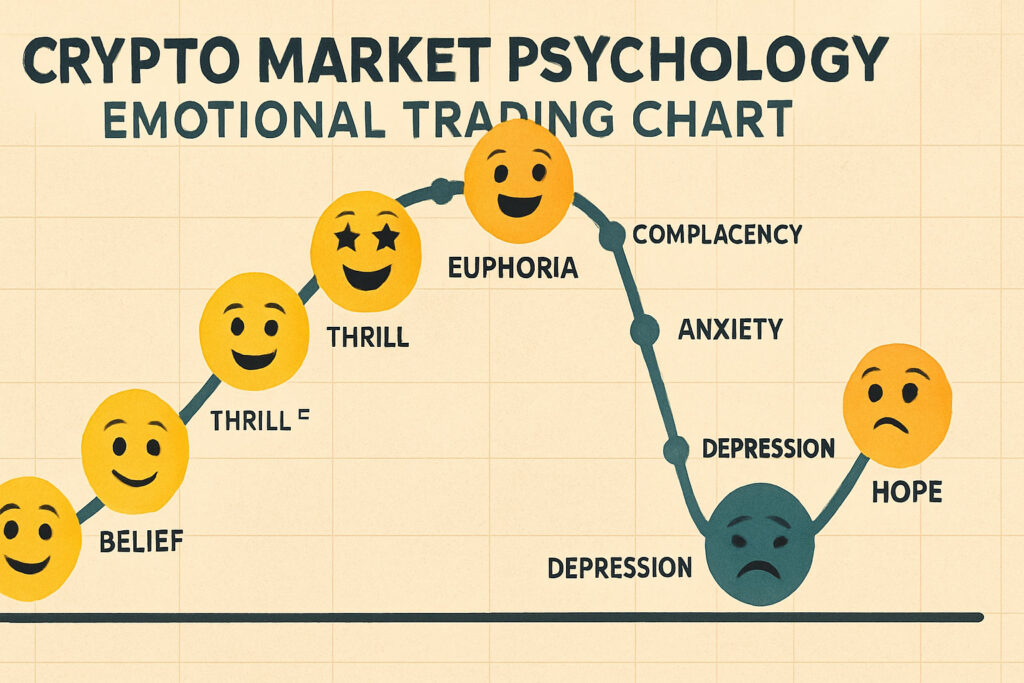
Most traders unintentionally cycle through predictable emotional loops. Understanding this cycle helps you break out of it. A typical loop looks like this:
- Optimism
- Excitement
- Euphoria
- Anxiety
- Denial
- Panic
- Capitulation
- Depression
- Hope
- Relief
This cycle maps directly to market phases. Recognising where you are helps you avoid irrational behaviour.
Practical Tools to Rebuild Emotional Discipline
Psychology improves through structure. Just like a security analyst uses a log file to track anomalies, you need a system to log emotional triggers and identify patterns. One of the most effective frameworks is keeping a mental journal, such as adding entries to your Crypto Mental Log journal.
1. The PREP Framework
PREP stands for:
- Pause
- Reflect
- Evaluate risk
- Proceed with intention
This sequence slows down impulsive activity long enough to force your rational brain back into control. I’ve seen traders completely transform by applying a 30-second PREP rule before any entry or exit.
2. Stress Regulation Techniques
Traders underestimate how much chronic stress erodes decision-making. Rebuilding control starts with managing stress before it escalates.
Techniques include:
- Breath cycle resets
- Time-blocked trading windows
- Pre-set stop-loss & take-profit automation
- Screen breaks every hour
3. A FUD Resistance Strategy
Fear, uncertainty, and doubt (FUD) often impacts newer traders most. Building resilience involves strengthening your information hygiene – what sources you trust, how you validate claims, and how quickly you react.
We’ve broken this down in a dedicated guide on fud reduction, which covers practical filtering, bias awareness, and strategic thinking.
4. Rules for Avoiding Revenge Trading
Revenge trading usually hits after a high-stress losing streak. It’s not a trading strategy – it’s an emotional outburst.
Three rules minimise the risk:
- Never open a new trade within 30 minutes of a significant loss
- Reduce position size for the next three trades
- Write a “loss post-mortem” in your journal
Our deeper guide on cutting out revenge trading breaks this pattern down further.
Comparison Table: Emotional Traps vs Counter Strategies
| Emotional Trap | Common Behaviour | Counter Strategy | Difficulty (1-5) |
|---|---|---|---|
| Fear | Panic selling | PREP Framework | 3 |
| Greed | Over-leveraging | Structured risk plans | 4 |
| Impatience | Forced entries | Time-block trading | 2 |
| Social influence | FOMO buying | Source filtering | 3 |
| Revenge trading | “Winning it back” trades | Cooldown + journaling | 5 |
Building a Professional Trader’s Mindset

A professional mindset isn’t about being emotionless. It’s about being emotionally aware, structured, and consistent. Long-term traders don’t avoid fear or greed – they manage them through systems, habits, and deliberate frameworks.
That’s why our guide on developing the mindset of a long-term trader is essential reading. It breaks the transition down from reactive trading to professional execution.
How to Integrate Market Psychology Into Your Daily Routine
Mastering psychology is a daily habit, not a one-off fix. Here’s a workflow you can immediately adopt:
- Start your session with a 3-minute emotional check-in
- Review yesterday’s journal notes inside your Crypto Mental Log
- Set strict entry/exit rules before touching the chart
- Limit social feeds to scheduled windows
- Apply the PREP rule before any order placement
Understanding Crypto Market Psychology FAQs
Because your emotional brain responds faster than your analytical brain. You can’t eliminate emotional responses, but you can build systems to override them.
Most traders see noticeable improvements within 30-60 days of consistent journaling and structured routines. Long-term mastery takes months to years.
Not realistically – but you can manage it effectively by limiting exposure to social media and building confidence in your own strategy.
Absolutely. Tracking emotional triggers gives you data to identify patterns, exactly like logs in cybersecurity.
Yes. Cortisol spikes impair decision-making, reaction times, and risk evaluation. Reducing stress is a performance enhancer.
Final Thoughts
Crypto trading is 20% strategy, 80% psychology. If you only optimise your tools and charts, you’re missing the biggest factor determining your success. The more you master your emotional responses – fear, greed, FUD, social pressure, impatience – the more you detach from market noise and trade intentionally.
Your next step is to start tracking your reactions today. Use your Crypto Mental Log journal and begin building the emotional resilience that separates long-term traders from everyone else.
If you found this content helpful,please consider sharing!: